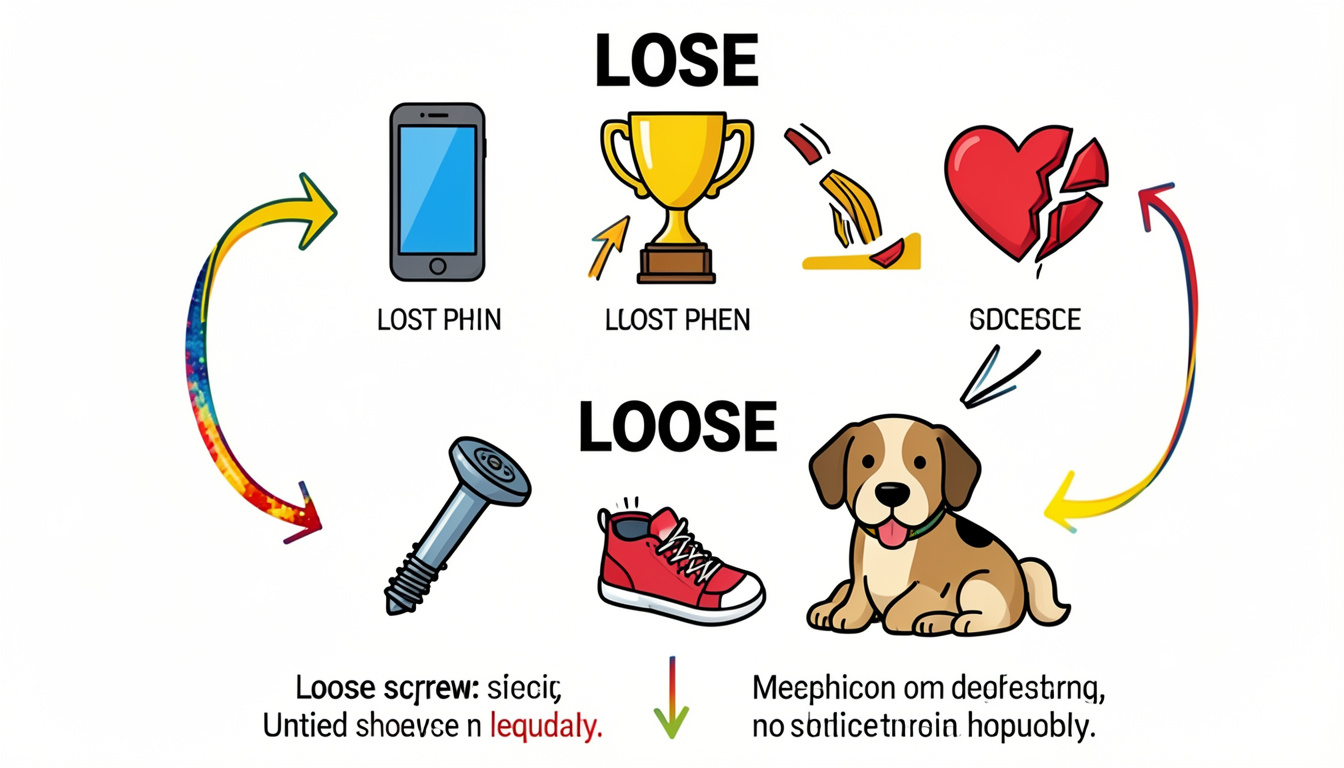
English can be tricky, and even native speakers often mix up certain words that look similar but mean completely different things. One of the most common mix-ups happens between “lose” and “loose” — two short words with distinct meanings, pronunciations, and grammatical functions. Understanding the Lose and Loose Meaning is essential not only for clear communication but also for professional writing, social media posts, and even business content where language precision matters.
Let’s explore these two often-confused words in detail, looking at how they’re used, what they mean, and how you can finally remember which one to use in your writing.
The Core Difference Between “Lose” and “Loose”
The word “lose” is a verb. It means to misplace something, fail to win, or no longer have something. For example:
- You can lose your keys.
- You can lose a game.
- You can lose your temper.
“Lose” indicates deprivation, failure, or absence — something you no longer possess.
On the other hand, “loose” is usually an adjective, describing something that is not tight, secure, or firm. For example:
- A loose shirt.
- A loose screw.
- A loose dog running down the street.
It emphasizes freedom or lack of constraint — describing a state of being untied, relaxed, or not fixed.
This basic distinction is the foundation of the Lose and Loose Meaning: “lose” relates to losing possession or control, while “loose” refers to the physical or metaphorical relaxation of tension or confinement.
Spelling and Pronunciation Guide
Although lose and loose differ by just one letter (“o” vs “oo”), that difference changes both sound and meaning.
- Lose is pronounced /luːz/ — with a ‘z’ sound at the end.
- Loose is pronounced /luːs/ — ending with a soft ‘s.’
That small sound change makes a big impact. Mispronouncing them can confuse listeners, and misspelling them can change the entire sense of a sentence. For instance:
- “I don’t want to loose my wallet” — incorrect.
- “I don’t want to lose my wallet” — correct.
If you say loose instead of lose, you end up implying your wallet isn’t tightly attached to something rather than missing altogether. That’s why understanding the Lose and Loose Meaning is crucial for accurate communication.
Common Mistakes People Make
This confusion arises because English speakers often type quickly, relying on spelling that “looks right.” Unfortunately, the double “o” in loose visually seems stronger — so people mistakenly use it when they mean “lose.” Here are some common examples:
- Incorrect: “Don’t loose hope.”
- Correct: “Don’t lose hope.”
- Incorrect: “You might loose money.”
- Correct: “You might lose money.”
The mistake can appear harmless, but imagine sending a professional email, marketing content, or academic paper with “loose” used incorrectly. It can subtly undermine your credibility and distract from your message.
To help remember: if you’re talking about something slipping away or failing to win, use lose. If something isn’t tight or fixed, use loose.
Practical Tips to Remember the Difference
Here’s a quick mnemonic trick:
- Lose has one “o” — you’ve lost one “o” because you “lose” something.
- Loose has two “o’s” — things that are “loose” have extra space, just as this word has an extra “o.”
That simple mental image helps fix the spelling difference permanently.
Another tip: Think of lose in the same category as “win” (its opposite). You can win or lose — both actions. Meanwhile, loose describes a condition, the opposite of “tight.” You can tighten or loosen something — both states of being.
Examples of Lose and Loose in Everyday English
Context is everything. To grasp the Lose and Loose Meaning, let’s look at how both words appear in different sentences and settings:
Lose examples:
- If you don’t back up your files, you might lose important data.
- Athletes train hard so they won’t lose critical matches.
- She didn’t want to lose touch with her old friends.
Loose examples:
- The mechanic noticed a loose bolt in the engine.
- This sweater feels loose around the shoulders.
- He let the dog loose in the park (here, “loose” is used as a verb meaning “to set free”).
Often, you’ll even see both words appear close together — especially when describing emotional or physical states — which is why knowing the precise Lose and Loose Meaning helps avoid embarrassing errors.
How Grammar and Context Shape Meaning
“Lose” primarily operates as a verb, taking different tenses: “lost” (past tense), “losing” (present participle), and “loses” (third-person singular). You can say:
- “I lost my phone yesterday.”
- “He’s losing patience quickly.”
- “She usually loses focus after lunch.”
Meanwhile, “loose” acts as an adjective, though it can also serve as a verb meaning “to release.” For example:
- “The screws are loose.” (adjective)
- “They will loose the horses.” (verb, though less common in modern English — often replaced with “release.”)
These grammatical functions further emphasize how the Lose and Loose Meaning diverges depending on sentence structure.
Why This Distinction Matters
Language precision isn’t just for grammar enthusiasts — it’s crucial for professional communication, marketing content, and everyday expression. A misplaced word can result in misunderstandings, lowered credibility, or even unintended humor.
For instance, imagine a brand slogan like “Never loose sight of your dreams.” Instead of an inspiring message, it sounds like the dreams are physically unfastened — not lost. Correct spelling ensures your message resonates clearly.
In SEO writing or digital content creation, accuracy matters even more. Google’s algorithm increasingly rewards linguistic clarity and penalizes misspellings in professional niches. So when targeting relevant keywords, ensure you correctly explain or use the Lose and Loose Meaning to add educational value and maintain linguistic integrity.
A Quick Comparison Table
Visual tables like this help cement understanding. If you’re learning English, print this out or save it in your notes — seeing the difference side-by-side works wonders.
Real-Life Application: Writing Better Emails and Content
In professional writing, small word errors can make big impressions. Whether you’re crafting a business proposal, online ad, or blog article, knowing the Lose and Loose Meaning ensures your writing stands out as polished and trustworthy.
Proofread your work for this pair in particular. If you see “loose” used in contexts involving lost opportunities or items, change it to “lose.” Likewise, if describing fit, size, or freedom, “loose” is correct. Over time, this habit will become automatic and drastically improve your writing accuracy.
Closing Thoughts
Mastering commonly confused words like these not only helps you write correctly but also strengthens your confidence in English usage. “Lose” and “Loose” might seem trivial, yet they perfectly illustrate how minor spelling shifts create huge meaning gaps.
So, the next time you draft an email, post a caption, or publish an article, think back to this guide on the Lose and Loose Meaning — the clear, easy way to keep your grammar tight and your expression loose only when it’s supposed to be!